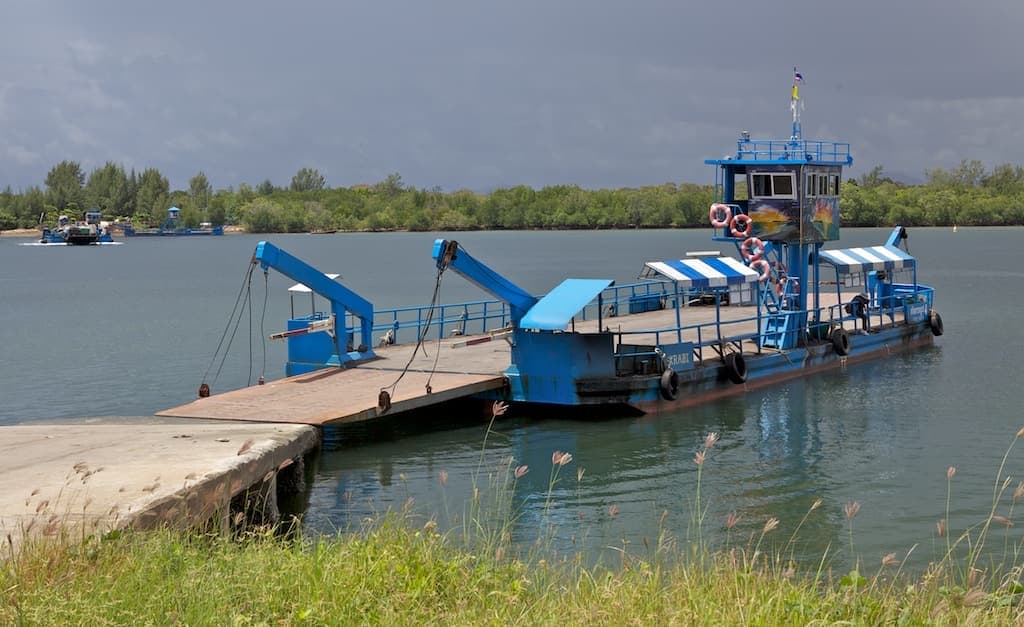
Koh Lanta Car Ferry: What to Know Before You Cross
A short, frequent crossing that most road transfers use rather than something you need to arrange yourself.

Summarize this page with AI
The car ferry (vehicle ferry) is a short crossing that connects the mainland route to Koh Lanta, carrying cars, minivans, motorbikes and their passengers across a narrow stretch of water near the island. It's a different service from the direct passenger ferries that run from Krabi in high season. This is the crossing built into the road route, and it operates far more consistently across the year, which is exactly why it becomes the main way onto the island outside the November–April ferry season.
If you're arriving by private transfer, taxi, or minivan, the driver handles the car ferry crossing as part of the trip. You'll typically stay in or near the vehicle for a short wait and a brief crossing, then continue by road. It's a normal, low-stress part of getting to Koh Lanta and not something most travellers need to book separately.
If you're driving or riding a rented motorbike yourself (for instance, arriving from Krabi town independently), you'll queue at the pier, pay a small crossing fee for the vehicle, and cross with your bike or car on board, crossings run frequently through the day rather than to a fixed timetable most of the time. Fees vary by vehicle type and aren't something we publish as a fixed number here since they can change; expect a modest cost for a motorbike and more for a car.
Expect some waiting time at busy periods, and follow signage and staff directions at the pier when driving on. If you're on a motorbike, ride on and off carefully, as ramps and decks can be wet and slippery.
Because the crossing is part of the road route, it is the reason the island is reachable by road even without an airport.
Where the car ferry goes
The road from Krabi runs south on Highway 4 to Ban Hua Hin Pier on the mainland. The car ferry crosses from there to Ban Khlong Mak Pier on Koh Lanta Noi, the smaller, flatter island to the north. From Lanta Noi you drive over the Siri Lanta bridge to Koh Lanta Yai, the island with the beaches, and through Ban Saladan before heading south. Ban Hua Hin Pier is in Krabi province and has nothing to do with the town of Hua Hin.
Until 2016 there was a second car ferry between the two islands. The Siri Lanta bridge, about 650 m long, opened on 22 April 2016 and replaced it, so today there is only one crossing on the way in.
| Step | From | To | Time published |
|---|---|---|---|
| Road | Krabi International Airport or Krabi Town | Ban Hua Hin Pier | Most of the journey; depends on traffic |
| Car ferry | Ban Hua Hin Pier | Ban Khlong Mak Pier (Koh Lanta Noi) | About 10 minutes (about 20 in another source), plus the queue |
| Road and bridge | Koh Lanta Noi | Koh Lanta Yai, via the Siri Lanta bridge | About 5 minutes by road |
| Road | Ban Saladan | Your beach | From about 5 minutes (Klong Dao) to 45 minutes (Kantiang Bay) |
Times as published by our sources, checked in September 2026 for our Koh Lanta map. The whole trip from Krabi Airport is roughly 1.5 to 3 hours door to door.
Car ferry, passenger ferry or speedboat
The car ferry is a flat vehicle boat that shuttles back and forth across a short strait; you cross in a few minutes and stay close to your vehicle. The passenger ferry is a separate boat for foot passengers from Klong Jilad Pier in Krabi Town straight to Saladan Pier, published at 1 h 30 to 2 h and running on schedules that cover November to April. Speedboats from Ao Nang, Phi Phi or Phuket also land at Saladan, mainly in high season.
If you want a way in that works in every month, the car ferry is it. If you are already in Krabi Town in high season and travelling light, the passenger ferry skips the road. Our ferry schedule guide compares the boats.
Queues, waiting times and the best time to cross
The crossing itself is short; the queue is what makes the difference. Published accounts mention waits of over an hour at the pier in high season, when minivans, private cars and trucks all converge on the one crossing for vehicles. With fewer visitors in the rainy season, the queue tends to be shorter.
You cannot book a slot, so the only lever is timing. On arrival day, leave a margin rather than planning a same-day boat trip or dinner reservation. On departure day, count the queue into your time to the airport and leave earlier than a map app suggests, especially from the southern beaches.
Crossing with your own car or scooter
- Fares: you pay per vehicle at the pier, with a car costing more than a motorbike. We do not print an amount because we could not verify a current one; keep some Thai baht in cash, see paying on the island.
- Rental cars: check that your rental agreement allows the ferry crossing and ask what the insurance covers on board.
- Scooters: many island rental shops do not allow bikes off the island. Ask first, see the motorbike rental guide.
- On board: follow the crew's directions, set the handbrake, and take valuables with you if you step out of the car.
- Coming back: the same crossing works in reverse from Ban Khlong Mak Pier, with the same queue risk.
Will a bridge replace the car ferry?
A second bridge to the mainland, about 2.5 km long, is under construction, with service expected in 2029 according to published reports (checked September 2026). Until it opens, the car ferry remains the only way for vehicles to reach the island. Treat the opening date as a projection, not a promise.
Frequently asked questions
No: the car ferry generally operates on a frequent, queue-and-board basis rather than pre-booked tickets, and if you're on a pre-arranged transfer, your driver takes care of it. If you're self-driving, just arrive at the pier and expect a short wait.
See the ferry schedule guideNo. The car ferry is a short vehicle crossing that's part of the overland road route, and it runs more reliably year-round. The passenger ferry is a separate, longer-distance boat service from places like Krabi town, and it mainly operates in the high season.
Motorbikes are carried on the vehicle ferry, but check your rental shop's terms before taking a bike off the island, since many shops restrict it.
Motorbike rental guideAbout 10 minutes on the water (another source gives about 20 minutes), checked September 2026. In high season the queue at Ban Hua Hin Pier can add over an hour.
Piers on the Koh Lanta mapYes. It is part of the road route and runs all year, which is why it becomes the main way onto the island when the passenger boats are reduced or suspended.
Koh Lanta in the rainy seasonLast verified 27 September 2026
Sources and further reading
Book your transfer or ferry to or from Koh Lanta
Pick your route and your travel date: you land on the 12Go results for that exact day, with departures and prices, one step from booking. The link is sponsored and costs you nothing extra.
Times, operators and prices are shown live on 12Go; we don't publish fixed timetables or fares here because they change.
Plan your days
Book the experiences that make the trip
Compare the best-rated Koh Lanta tours, check live prices and availability, and book in a few clicks.